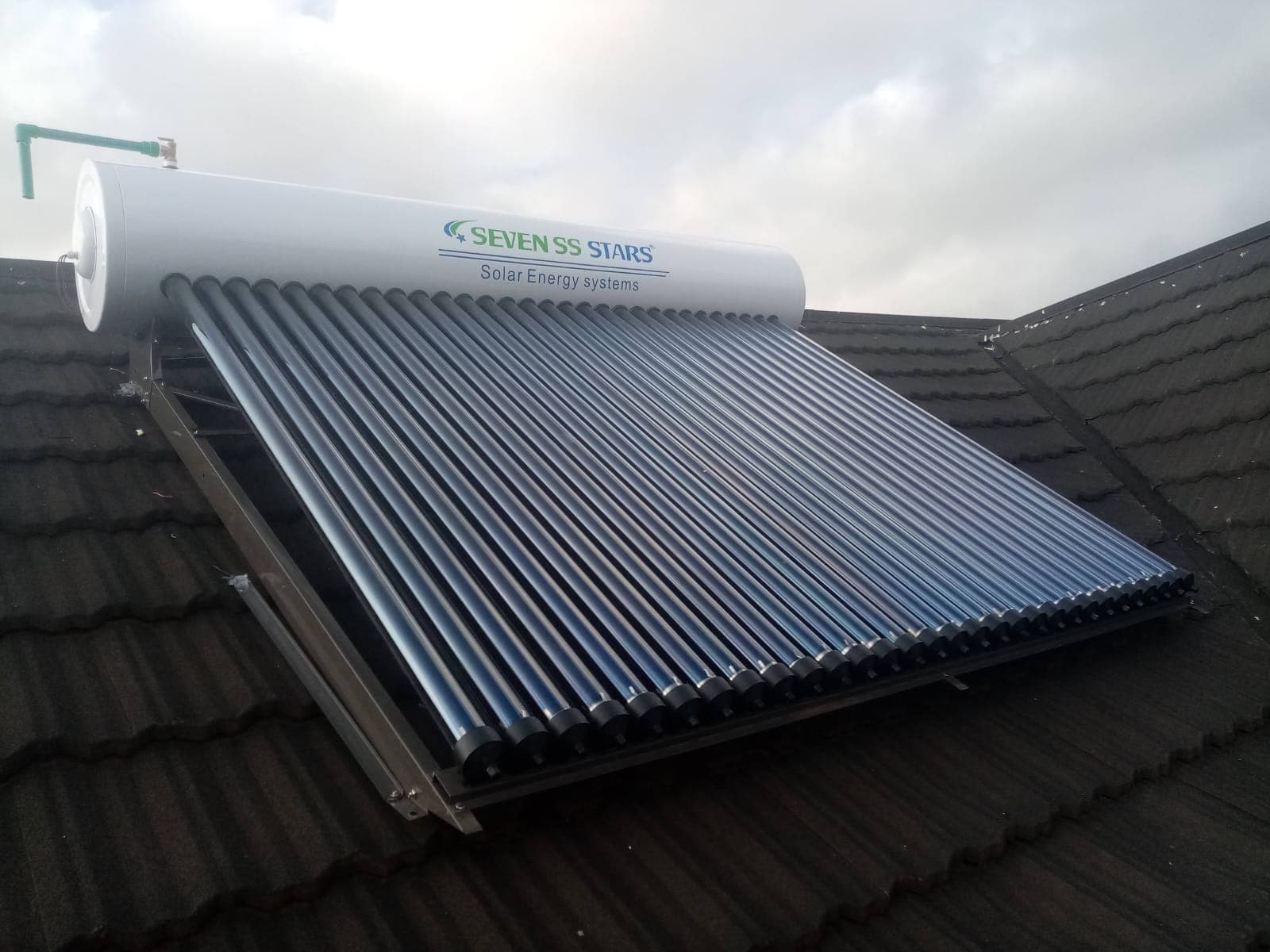
Every homeowner who calls us about a solar water heater asks the same first question: why does it cost so much more than a geyser? A 150L electric geyser from a hardware shop runs KES 15,000 to 25,000 including a basic install. A 150L solar water heater system runs closer to KES 150,000. On paper that looks like an easy decision. It isn't, once you look at what each one actually costs to run.
What an Electric Geyser Actually Costs You
A standard 150L geyser draws roughly 3kW while heating, and in most households it cycles on and off multiple times a day to maintain temperature, plus a full reheat each morning. Conservatively, a family of four running a geyser for a mix of showers and kitchen use will see it consume somewhere between 4 and 6 units (kWh) a day. At KPLC's domestic tariff, which sits above KES 25 per unit once you include fuel cost adjustment and levies, that is roughly KES 100 to 150 a day just for hot water.
Multiply that out and a geyser-heavy household is spending somewhere in the region of KES 3,000 to 4,500 a month on hot water alone. Over a year that is KES 36,000 to 54,000. Over 15 years, and geysers rarely last that long without an element replacement or two, you are looking at KES 540,000 to 810,000 in electricity for hot water, before accounting for tariff increases, which have been a near-annual event in Kenya.
What a Solar Water Heater Actually Costs You
The upfront cost is the sting: a 150L flat-plate or evacuated-tube system with tank, collector, mounting frame, and backup electric element installed runs from around KES 120,000 to 180,000 depending on brand and roof type. After that, the sun is doing almost all the work. The backup element only kicks in during extended cloudy spells, which in most of Kenya is rare enough that annual backup electricity use is a small fraction of what a geyser burns through in a single month.
Realistic ongoing cost for a solar system: a few hundred shillings a month in backup element use, plus an annual inspection. Call it KES 3,000 to 5,000 a year in total running cost, against 15 years that's KES 45,000 to 75,000, plus the upfront hardware.
The 15-Year Total
Upfront ~KES 20,000 + 15-year running cost ~KES 540,000-810,000 + one or two element/tank replacements ~KES 30,000-50,000. Total: roughly KES 590,000-880,000.
Upfront ~KES 120,000-180,000 + 15-year running cost ~KES 45,000-75,000 + occasional valve/seal servicing ~KES 15,000-25,000. Total: roughly KES 180,000-280,000.
Even at the pessimistic end, a solar water heater pays for its own upfront cost difference within 2 to 4 years, which matches what our own service data shows across installed systems, and then simply keeps saving money for the next decade or more. This is the payback window we quote clients, and it holds even if you assume a modest household that showers less than the 4-6 units a day figure used above.
The Numbers That Don't Show Up on a Spec Sheet
- •Tariff risk: Every year the geyser gets more expensive to run. The solar system's running cost barely moves.
- •Outage resilience: A geyser is useless the moment KPLC cuts power. A solar water heater with a full tank keeps giving you hot water regardless.
- •Element life: Geyser heating elements in hard-water areas of Kenya often need replacing every 3-5 years, an ongoing cost most people forget to budget for.
- •Resale value: A solar water heater is a visible upgrade that buyers and tenants notice and will often pay a premium for.
If you want the payback numbers run against your actual household size and roof, our solar water heater installation service includes a free assessment that gives you a realistic monthly saving estimate before you commit to anything.
When a Geyser Still Makes Sense
To be fair to the geyser: if you are renting short-term, or your roof genuinely cannot take a tank and collector (some flat-roof apartment blocks restrict rooftop installations), the lower upfront cost of a geyser is the only realistic option. For anyone who owns their home and plans to stay more than 3 to 4 years, the maths above is difficult to argue against.
Want your own numbers, not just averages?
We'll size a solar water heater system to your household and roof and give you a real payback estimate based on your electricity bill, not a generic figure.
Book a Free Assessment