For decades, a solid masonry wall has been the default answer to "how do I secure my boundary" in Kenya. It's not a bad answer, walls work. But a growing number of commercial and institutional properties, and a fair number of residential ones, are choosing anti-climb clear-view mesh instead, and the reasoning behind that shift is worth taking seriously rather than dismissing as a trend.
The Core Argument: Visibility Is a Security Feature, Not a Weakness
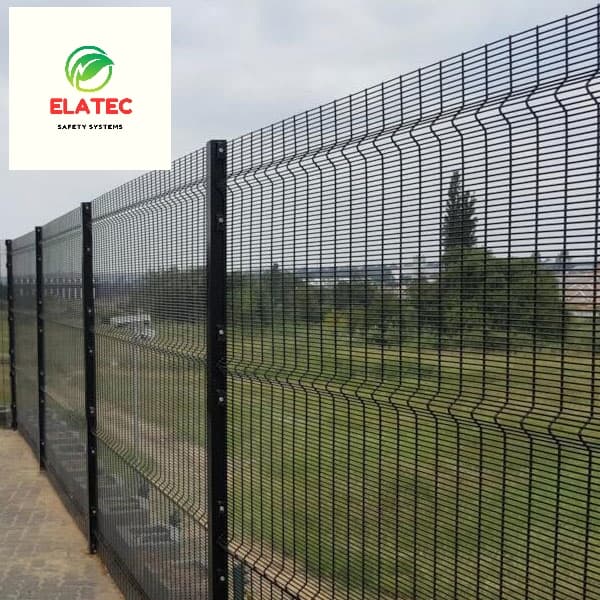
A solid wall's security logic is concealment and physical obstruction, you can't see in, and you can't easily get over it. Clear-view fencing, specifically 358 mesh with its 76.2mm x 12.7mm aperture, flips the concealment part of that logic entirely: it's difficult to climb and difficult to cut with standard tools, but it's fully see-through by design.
That visibility cuts both ways, and that's the actual point. Security personnel, cameras, and passing patrols inside the property can see anyone approaching the boundary from outside, and anyone outside can see there's active surveillance and activity on the property, which is itself a deterrent. A solid wall gives an intruder cover to work at the boundary unobserved, a clear-view fence doesn't.
Where This Argument Is Strongest
This case is most compelling on commercial and institutional properties, offices, schools, warehousing, where perimeter monitoring is already an active practice rather than a passive hope. A 358 mesh boundary lets security staff and CCTV actually do their job along the full fence line, instead of a camera pointed at a blank wall that tells you nothing until something's already happened on the wrong side of it.
This is the reasoning behind installations like the one on our clear-view fence service page , including a 358 mesh boundary in Karen where open sightlines across the grounds were the deciding factor over a solid wall.
The Honest Counter-Case for Solid Walls
This isn't a case that clear-view fencing is strictly better in every situation, it isn't. Solid walls still win decisively where privacy is the primary requirement rather than a secondary preference, residential compounds where you genuinely don't want your compound visible from the road, or properties where noise or dust screening matters as much as security. A wall also doesn't require the same commitment to active monitoring that makes clear-view fencing worth its premium, a see-through boundary with nobody watching it is arguably worse than a wall, since it invites a false sense of security without the concealment upside.
There's also a middle path plenty of properties choose: clear-view mesh for the security backbone, with privacy netting fitted selectively along specific sections, pool decks, private garden areas, rather than the full perimeter. You get the visibility advantage where it matters most and concealment where it's actually wanted.
What's Actually Driving the Shift
- •CCTV adoption: As more Kenyan properties invest in perimeter camera coverage, a wall that blocks the camera's own view of the boundary line itself becomes a design conflict worth resolving.
- •Anti-climb performance: 358 mesh's small aperture makes it genuinely harder to scale than most people assume walls are, which closes the security gap that used to favour solid barriers by default.
- •Electric fence integration: Clear-view panels topped with an electric fence trellis arm combine two security layers cleanly, something that's more visually awkward to retrofit onto an existing solid wall.
- •Cost over large perimeters: On very long boundary runs, mesh panel and post fencing can compare favourably against masonry wall construction, though this varies significantly by site and should be quoted specifically.
The honest version of this argument isn't "walls are obsolete," it's that clear-view fencing has become a legitimate default worth actively considering rather than an unusual choice, particularly anywhere active security monitoring is already part of the plan. The right answer still depends on what a specific property actually needs concealed versus what it needs watched.
Weighing a wall against clear-view fencing?
Book a free site survey and we'll walk through the security and privacy trade-offs for your specific boundary, no default assumption either way.
Book Free Survey