"How many joules do I need?" is the single most common question we get from clients who have done a bit of shopping before calling us, and it's usually asked with a vague sense that bigger is better. It isn't, not automatically. Here's what the joule rating actually measures, why it matters, and how the rest of an energizer system fits together.
What a Joule Actually Measures Here
A joule is a unit of energy. In the context of a fence energizer, the joule rating describes the energy delivered in each individual pulse, not the voltage. This distinction matters: voltage is what makes the pulse feel sharp and travel far along the wire, energy (joules) is what determines how much of a jolt is actually delivered on contact. A fence can run at a high voltage with a low joule rating, which is exactly the combination that makes electric fencing effective as a deterrent without being dangerous: enough voltage to push the pulse the length of a long fence run and produce a sharp, attention-getting shock, but low enough stored energy per pulse to keep it non-lethal.
The pulse itself is extremely short, a few thousandths of a second, and repeats roughly once per second. That on-off pattern is deliberate. A continuous current at the same voltage would be genuinely dangerous. A pulsed current at the same voltage is a memorable deterrent.
Matching Joules to Fence Length
Voltage drops off as it travels along a fence wire, particularly on longer runs, through vegetation contact, or in wet conditions. That's why energizer output is roughly matched to expected fence line length rather than picked at random:
Small residential plots and short single-wall runs. Entry-level mains units like the Hammer EZ 630 or Zareba EAC10M-Z fall in this range.
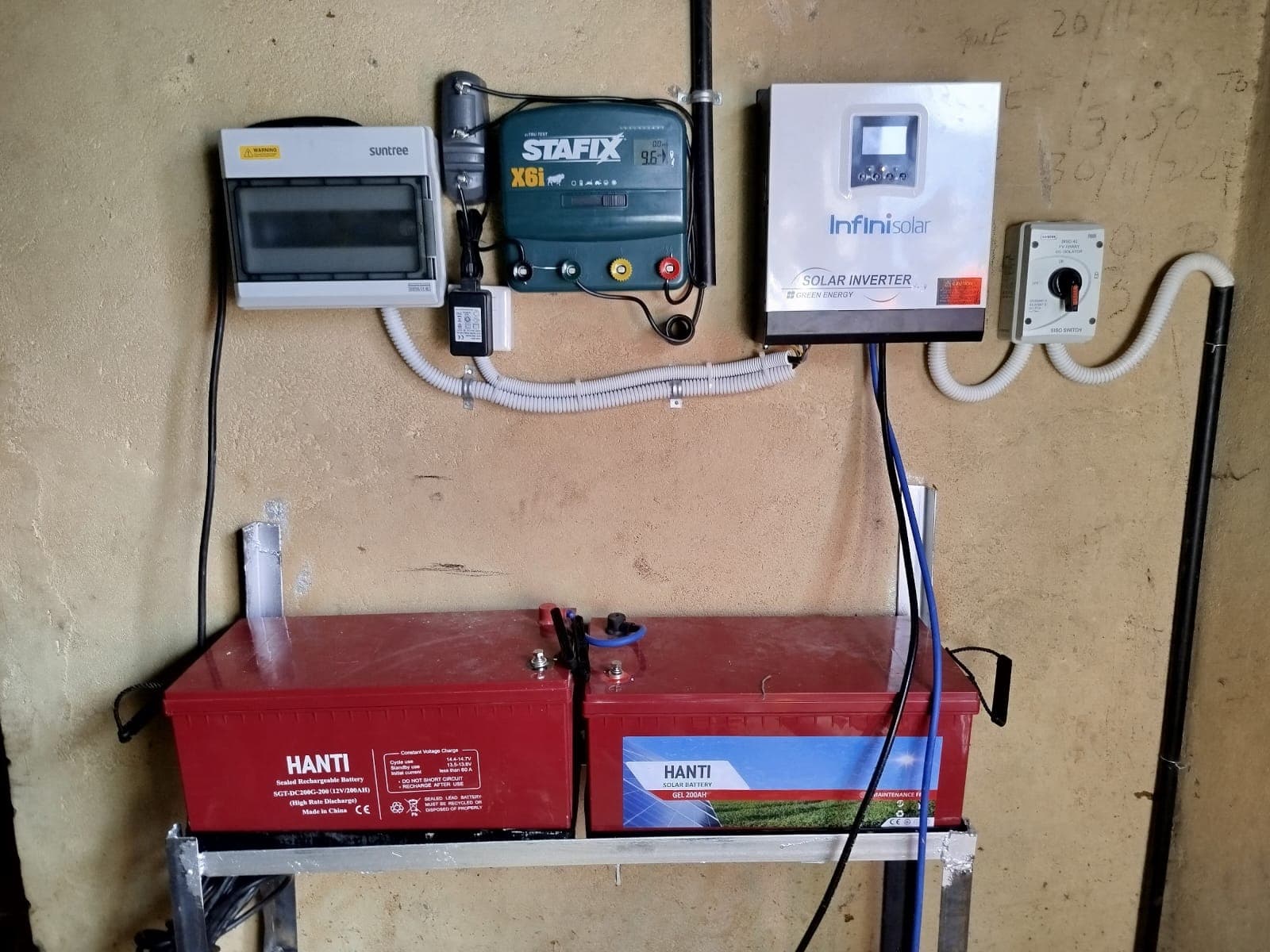
Standard Kenyan residential perimeter, the most common bracket for a typical 40x80 or 50x100 plot wall-top fence. The Stafix X3i and X6i sit here.
Larger residential compounds, commercial perimeters, or longer freestanding farm boundary runs. Stafix X12i/X18i and Nemtek Druid-series units fall in this range.
Extended agricultural, ranch, or multi-boundary commercial fence networks with several kilometres of wire, where voltage drop over distance is the primary design constraint.
Oversizing isn't harmless. Fitting an 18 joule commercial-grade unit onto a small compound wall doesn't make the fence "extra safe," it pushes the installation outside the output limits that keep a residential fence within SANS 10222's safety envelope. Undersizing has the opposite problem: the pulse may simply not reach the far end of a long fence run with enough energy left to register.
Zone Monitoring: How the Fence Knows It's Been Touched
A basic energizer just pulses the wire and stops there, it doesn't know or report anything. Zone monitoring modules sit between the energizer and the alarm system, watching the electrical characteristics of the fence line in real time. When a wire is cut, shorted to earth (by contact, wet vegetation, or a deliberate bridge), or its resistance changes in a way consistent with tampering, the module registers a fault on that specific zone and can trigger a siren, an SMS alert via a GSM communicator, or an integration with CCTV recording. Multi-zone units (Nemtek's Merlin 2B or JVA's Z28, for example) split the fence line into independently monitored sections, so a fault on the back boundary doesn't just say "something happened somewhere," it says which section.
Earthing: The Part That Actually Determines If Any Of This Works
Every pulse the energizer sends out has to return through a complete circuit, out along the live wire, through whatever it contacts, and back to the energizer through the earth. A dedicated earth spike system (typically several galvanised rods driven into consistently damp ground, well separated from the property's household electrical earth) gives that return path low resistance and keeps it reliable in both wet and dry conditions. Get earthing wrong and the whole chain above it, joule rating, zone monitoring, alarm integration, becomes unreliable, because the fault detection and the shock delivery both depend on a clean return circuit. This is the single most under-specified part of budget electric fence installations.
Mains-Powered vs Solar Energizers: What Actually Changes
A mains-powered energizer draws continuous AC power from the property's electrical supply and typically pairs it with a 12V sealed lead-acid battery for backup during outages, giving roughly 12 to 24 hours of runtime if KPLC goes down. A solar energizer (JVA's SV-series units, for instance, ranging from 2 to 20 joules) instead runs off a small dedicated solar panel charging its own battery bank continuously, with no mains connection required at all. The circuit-level trade-off: solar units are typically lower joule output at a given price point than an equivalent mains unit, because the panel and battery sizing constrains how much energy can be stored and delivered, but they're the only sensible option for boundary runs on farm and ranch properties with no nearby power connection, or as a fully outage-proof setup on any property.
Getting the joule rating, zone count, and earthing method right for your specific fence length and property type is a sizing exercise, not a guess, and it's exactly what a proper site survey is for. Browse the full range of energizers, from 0.5 joule entry units to 46,000-W commercial systems, in our electric fence shop category or book a survey and we'll spec it for your actual boundary.
Not sure what output your property needs?
Fence length, terrain, and risk level all affect the correct joule rating. Book a free site survey and we'll size the system properly.
Book Free Survey