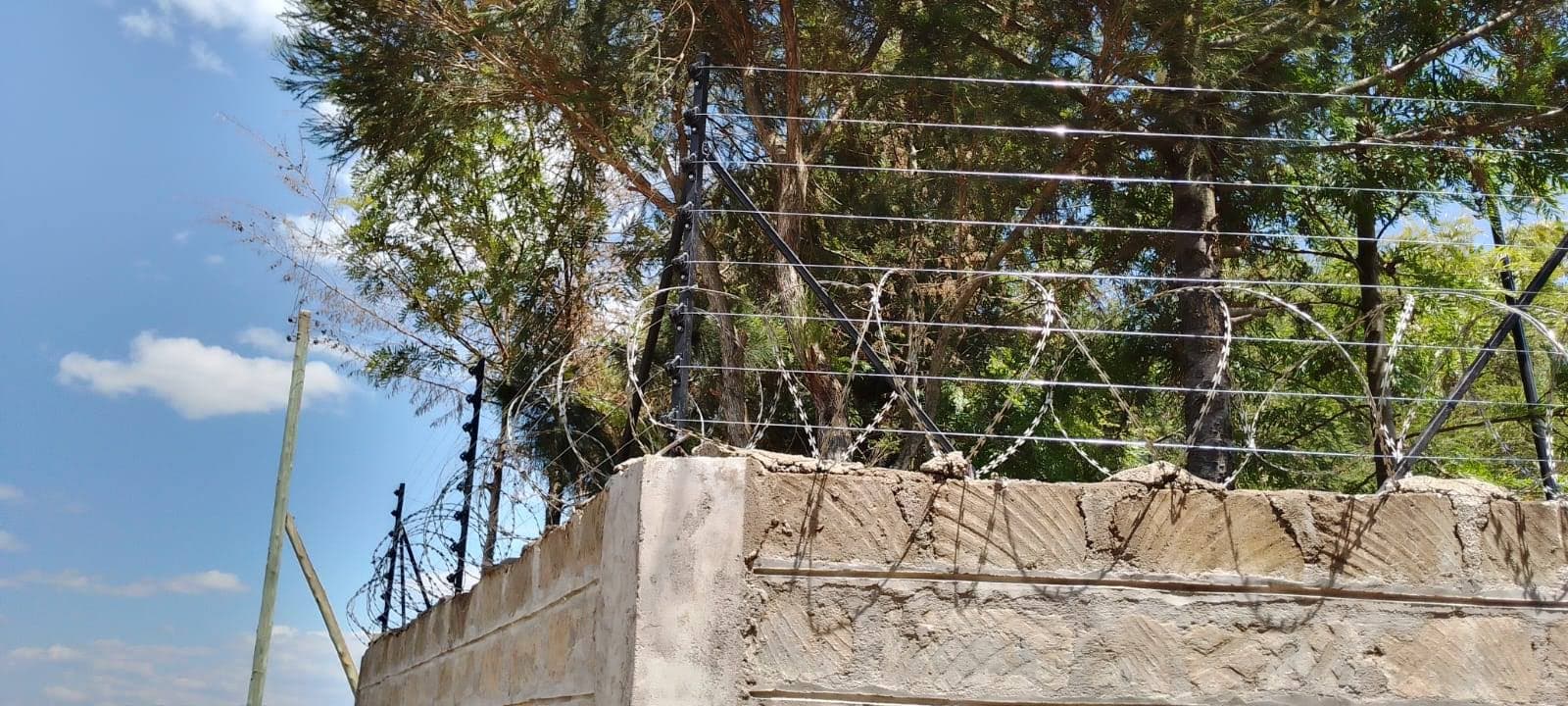
The scenario below is illustrative, not a report of a specific verified incident. It's built from the pattern of break-in attempts installers and security teams across the Laikipia and Nanyuki corridor describe when asked what actually happens on the ground. We're presenting it this way deliberately: as a realistic composite, not a real client's story, because the shape of the event matters more than any single detail.
11:40pm
A farmhouse on the edge of a large plot outside Nanyuki, timber-post electric fence running the full boundary, mixing open farmland with a treeline on one side, the kind of freestanding fence line common across ranch and farm properties in this part of the country. The household is asleep. Two men approach from the treeline side, where cover is easiest and the fence disappears into shadow.
11:47pm
One of them tests the lowest wire strand with the back of a gloved hand, an old, half-effective trick against fences that are weakly earthed or underpowered. This fence isn't. The energizer is rated correctly for the length of run, properly earthed with a dedicated spike system, and the pulse lands as designed: sharp, immediate, unmistakable. He recoils, swears, and the pair retreat several metres to reassess.
11:49pm
This is the part that rarely gets told in the shorter version of these stories: the fence doesn't just deliver a shock and stop there. The zone monitoring module on this installation registers the fault created by contact with the wire and triggers the linked siren and an alert to the property's control panel. What would otherwise have been a silent, unnoticed test of the perimeter becomes a noisy, obvious one. The household wakes. Security lighting on a separate circuit comes on across that section of boundary.
11:52pm
Faced with a lit, alarmed, and clearly still-live boundary, the two abandon the attempt and leave the way they came. No further contact with the fence. No entry. The whole incident, start to finish, lasts about twelve minutes, and the property owner's actual experience of it is being woken by a siren, checking the camera feed covering that stretch of fence, and seeing two figures leaving through the treeline.
Now Run the Same Night on a Bad Installation
This is the part worth sitting with. Change three things about this fence and the ending changes with it. If the energizer is undersized for the fence length, the pulse reaching that far corner of the property is weak enough to barely register, more nuisance than deterrent. If the earthing is poor, corroded, or shared with the house's general electrical earth, the same test-touch might produce an inconsistent, easily-shrugged-off shock instead of a sharp one. If there's no zone monitoring wired to an alarm, the fence can be touched, tested, and even breached with nobody in the house any the wiser until morning.
None of those three failure points are exotic. They're the same shortcuts covered in most electric fence compliance checklists: wrong energizer sizing, weak or missing earthing, no alarm integration. A fence that looks identical from the road, wire strands, posts, a warning sign, can be doing an entirely different job depending on what's actually behind the visible parts.
The difference between these two versions of the same night isn't luck, it's specification. Correct joule rating for the fence length, a dedicated earth system, and zone monitoring wired to an alarm are not premium extras, they're what makes an electric fence actually function as a deterrent rather than a decorative wire. See our electric fence service for what a properly specified installation includes, and browse real completed installations across farm and residential properties.
What This Scenario Is (and Isn't) Trying to Say
This isn't a claim that a fence alone stops every determined intrusion, no security layer does that, and we'd never suggest otherwise. It's a demonstration of how much the details of an installation matter to the outcome of a genuinely realistic scenario. A fence that has been sized, earthed, and monitored correctly changes the maths for anyone testing it. A fence that hasn't been doesn't.
Elatec has installed and serviced freestanding farm and ranch boundary fences across Laikipia, Nanyuki, Nakuru, and Meru, the kind of long, treeline, or open-farmland runs this scenario describes. Browse our completed projects to see the real installations, timber and galvanised posts, wire runs, and zone setups, behind this kind of work.
Protecting a farm or large boundary?
Freestanding fence lines need different sizing and earthing considerations than a wall-top residential fence. Book a free site survey and we'll spec it correctly the first time.
Book Free Survey