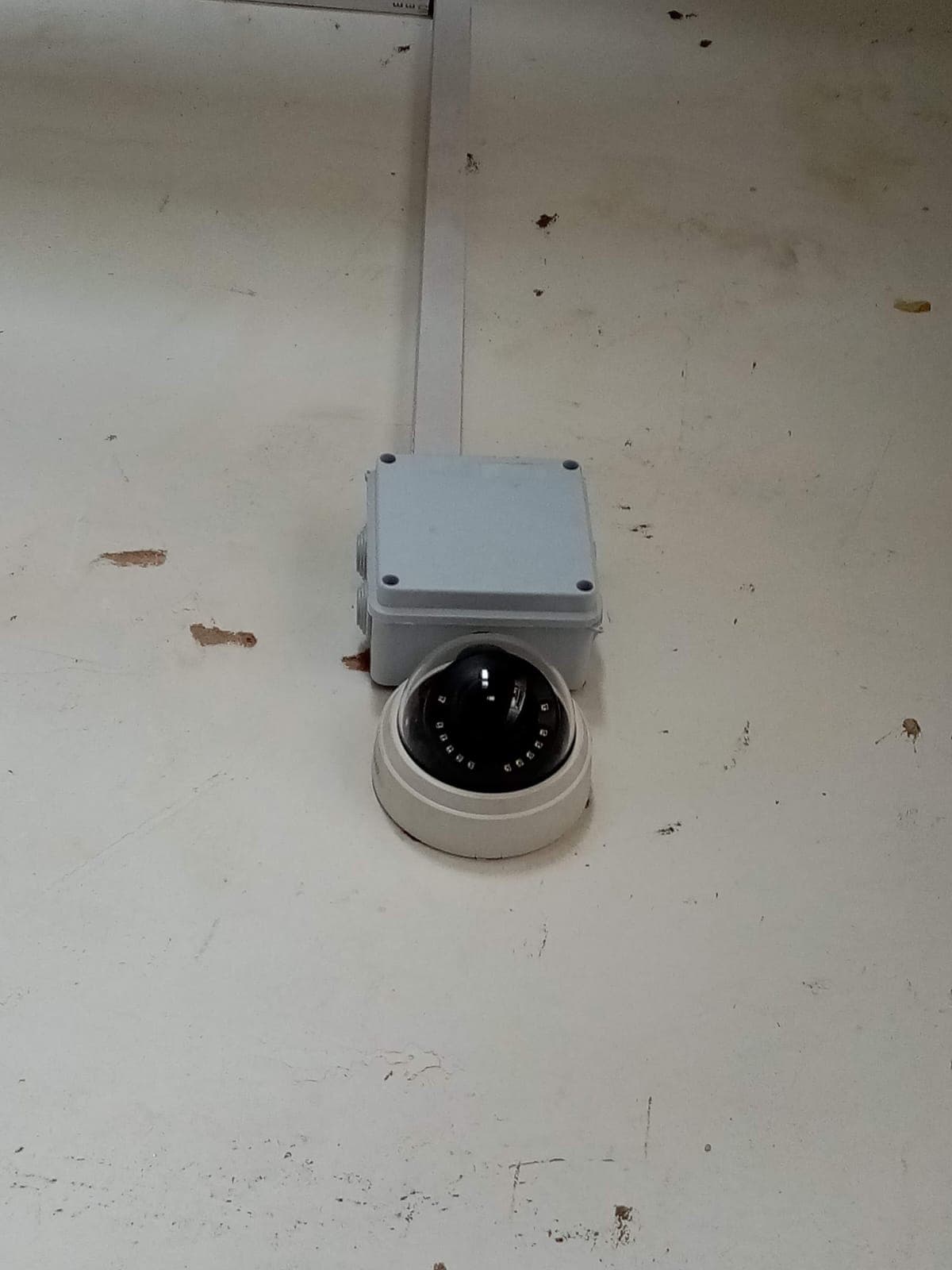
Most buyers spend their decision-making energy on camera resolution and brand, then treat cabling as an afterthought for the installer to sort out. That's backwards. The cabling technology you choose determines your maximum cable run, your future upgrade path, your power arrangement, and a meaningful chunk of your installation cost. Understanding the difference between PoE (Power over Ethernet) IP systems and analog HD-CVI systems will make you a far more informed buyer.
How analog HD-CVI systems work
HD-CVI (High Definition Composite Video Interface) is the modern evolution of old-style analog CCTV. It sends video over standard coaxial cable, the same RG59 cable used for decades, but with the bandwidth to carry HD resolutions (2MP, sometimes higher on newer chipsets) instead of the fuzzy standard-definition footage of older analog systems.
Power is a separate concern in HD-CVI systems. Each camera needs its own 12V DC power run, either from a local power supply near the camera or from a centralised multi-output power box back at the DVR. This means two cables to manage per camera: the video coax and the power line. In practice, installers use a combined video-and-power cable (sold as a single RG59 + power roll, exactly what's stocked for this purpose) to simplify the run, but it's still functionally two separate circuits bundled together.
How IP over PoE systems work
IP cameras send digital video data over standard Cat5e or Cat6 network cable, the same cable used for office LANs. PoE (Power over Ethernet) allows a single cable to carry both the data signal and the electrical power the camera needs, eliminating the second power cable entirely. The camera plugs into a PoE-enabled NVR or a PoE network switch, and both power and video travel down one cable.
This single-cable simplicity is the single biggest practical advantage of PoE systems for new installations: fewer cable runs, less labour, fewer points of failure, and a cleaner cable management job overall.
Distance limits: where each technology hits a wall
Standard Cat6 Ethernet, and therefore standard PoE, is limited to roughly 100 metres before signal degradation becomes a problem. Beyond that you need PoE extenders, fibre media converters, or a different architecture entirely (fibre backbone with PoE switches at each building, for example, which is standard practice on larger estates and industrial sites).
HD-CVI over coax can run further on the video side (typically up to 300 to 500 metres depending on cable gauge and signal quality), but remember the power line has its own separate voltage-drop limit, which is often the tighter constraint on longer runs. For a property with cameras spread across a genuinely large compound, this trade-off matters: coax may get your video signal further, but you'll need to think carefully about power delivery at that same distance.
Compression: H.264 vs H.265
This is a separate axis from the cabling choice but gets bundled into the same conversation because it affects storage and bandwidth planning either way. H.265 (also called HEVC) compresses video roughly 40 to 50% more efficiently than the older H.264 standard, meaning a camera recording in H.265 uses significantly less hard drive space and less network bandwidth for the same visual quality. Most current-generation Hikvision, Dahua, and Uniview NVRs and IP cameras support H.265 or the manufacturer's proprietary enhanced variant (H.265+), and it's worth confirming this is enabled by default on any new system, since it directly extends how many days of footage your hard drive can hold before it starts overwriting.
Which should you choose?
IP/PoE is usually the better long-term choice. Single-cable runs simplify installation, higher resolutions are cheaper to reach, and the network infrastructure doubles as a foundation for future additions like video intercoms or access control on the same backbone.
A hybrid Penta-brid DVR (supporting HDCVI, AHD, TVI, IP, and standard analog on one recorder) lets you replace cameras gradually without ripping out existing coax runs, then migrate to IP over time as budget allows.
Coax's longer video-only distance, or a fibre backbone feeding PoE switches at intervals, both outperform standard Cat6 PoE run in a single unbroken stretch.
In practice, the majority of new residential and SME installations in Nairobi we handle today are IP over PoE, simply because cable runs on a typical plot rarely exceed 100 metres, and the single-cable simplicity saves real labour cost. Larger estates and industrial sites tend toward a mixed architecture: fibre or coax for the long perimeter runs, PoE for everything within range of a switch.
Not sure which architecture fits your property? Our technicians assess cable run distances and existing infrastructure during every site survey before recommending a system. Browse compatible NVRs, DVRs, and PoE-ready cameras
Get a cabling plan matched to your property
Book a free site survey and we'll map out the right cabling architecture, whether that's a clean PoE run, a hybrid upgrade, or a fibre-fed perimeter, before you spend a shilling on equipment.
Book Free Survey