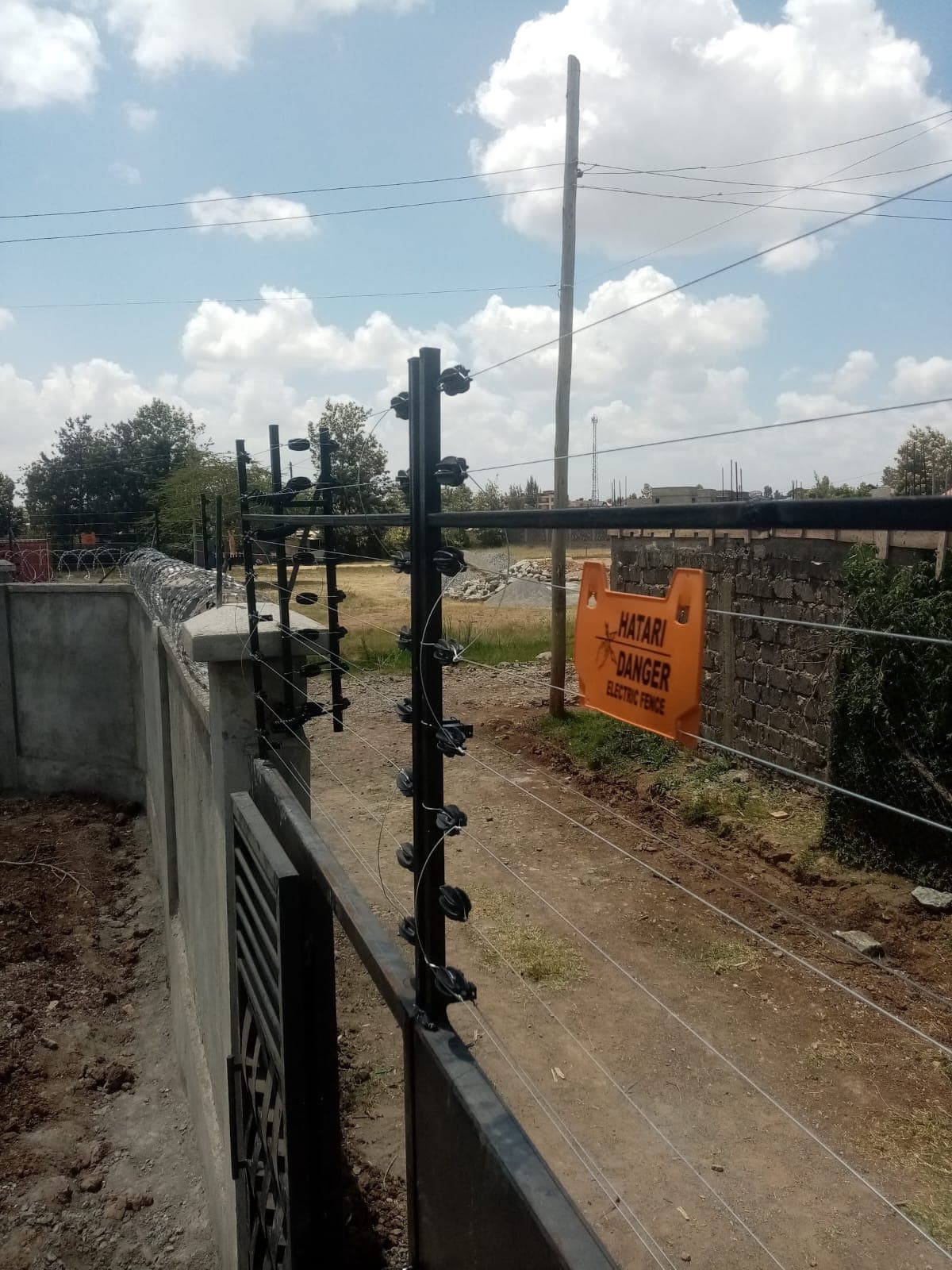
We get called out for a fair number of second-opinion visits: properties where an electric fence was installed by someone else, often years ago, and something has started to feel off, weak shocks, no alarm response, a neighbour's complaint about signage. Almost every one of these visits turns up the same handful of shortcuts. Here's what to check.
1. You Can't Find a Single Earth Rod
Walk the perimeter of your property and look for a small cluster of galvanised rods driven into the ground near the energizer, usually close to a wall or fence corner. If you genuinely can't find any dedicated earth spikes, or the energizer's earth wire is simply clipped onto the house's existing electrical earth, that's a real problem, not a cosmetic one. Earthing is what completes the circuit safely; skipping it or sharing it with household wiring is one of the most common and most consequential shortcuts we find.
2. Warning Signs Only at the Gate
SANS 10222 requires signage at intervals along the entire fence run, not just at the main entrance. If your property has one sign bolted to the gate and nothing else along several hundred metres of wall-top wire, that's both a compliance gap and, frankly, a sign the installer didn't take the rest of the job much more seriously either.
3. The Energizer Output Doesn't Match Your Fence Length
A tiny 0.5 joule mains unit trying to push a pulse around a long, multi-sided commercial perimeter will feel noticeably weak at the far corners, sometimes barely detectable. Conversely, a commercial-grade 18+ joule unit fitted to a small residential plot is oversized for the application. If nobody explained why they picked the specific model they installed, or the choice seems to have been "whatever was cheapest that day," ask for the sizing logic.
4. No Zone Isolation Where the Fence Meets Razor Wire
A huge number of Kenyan properties run electric fence wire alongside or just above razor wire coils on the same wall-top brackets. Done properly, the live strand is isolated from the razor wire so current doesn't travel where it shouldn't. Done carelessly, contact between the two can create shock hazards in places nobody expects, or drain the fence's output through the metal coil itself.
5. There's No Battery Backup, or Nobody Knows If There Is
Ask what happens to your fence during a power cut. If the honest answer is "it just goes off," the installation is missing a basic 12V backup battery, standard on essentially every reputable installation today, giving 12 to 24 hours of runtime during an outage. If nobody can answer the question at all, that's its own warning sign about how thoroughly the system was explained at handover.
6. No Handover Testing, No Documentation
A proper installation ends with the installer testing output voltage at multiple points along the fence line, confirming it's within correct range, and walking the client through the panel, zones, and any alarm integration. If your fence was simply switched on with no walkthrough, no test readings, and no explanation of what each part does, there's a reasonable chance testing wasn't done thoroughly, or at all.
If two or more of these sound familiar, it's worth having the installation independently checked rather than waiting for a fault to surface at the worst possible time. We offer inspection visits specifically for existing fences installed by other contractors. See our electric fence service for full details on what a compliant installation includes.
Worried about an existing installation?
Book an independent inspection. We'll check earthing, signage, output, and zone integrity and give you a straight answer.
Book an Inspection