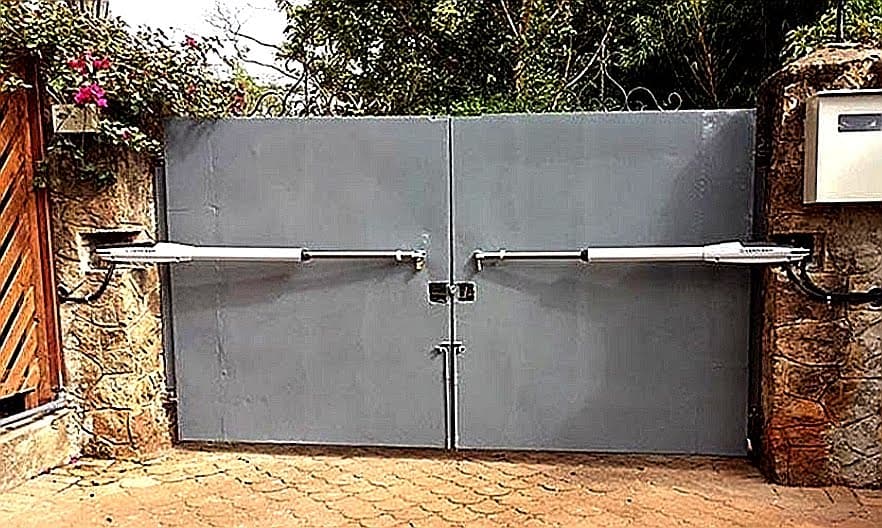
Before anyone asks about brand, remote controls, or backup batteries, the first decision in any gate automation project is mechanical: does your gate slide sideways along a track, or swing open on hinges like a door? Get this wrong at the design stage and no motor, however good, will fix it.
Swing Gates: The Traditional Choice
Swing gates open outward or inward on hinges, the same way most steel and wrought-iron gates in Kenyan estates and homes have always worked. They suit properties with enough clearance in front of or behind the gate line for the leaf to swing through its arc, and they tend to look more decorative, since ornate ironwork and crests read better on a hinged panel than a sliding one.
Swing gate motors from FAAC and Centurion typically handle up to 200 to 300kg per leaf. On a double-leaf gate, that is comfortable for most residential steel gates. The FAAC 400 kit, for instance, is rated to 200kg per leaf and is a common fit for family homes.
Sliding Gates: The Space-Saver
Sliding gates run along a horizontal track and retract to one side, which makes them the only sensible option where the driveway slopes steeply, where there is no room for a gate to swing without hitting a parked car or a wall, or where the road right outside the gate is too narrow for an outward swing to be safe.
Sliding motors also scale further up the weight range. The CAME BX-78 handles gates up to 400kg, the Centurion D5-Evo goes to 500kg, and heavy-duty units like the Centurion D10 Turbo and D20 SMART are rated for 1,000kg and 1,500kg respectively, which is why virtually every warehouse, factory, and large commercial gate in Nairobi runs on a slider rather than a swing arm.
Quick Comparison
| Factor | Swing Gate | Sliding Gate |
|---|---|---|
| Space needed | Clear arc in front/behind gate | Clear run along the fence line |
| Sloped driveways | Can bind or drag on slopes | Handles slopes well |
| Typical weight limit | Up to ~300kg per leaf | Up to 1,500kg (heavy-duty units) |
| Best for | Homes, ornate gates, narrow plots with setback | Wide entrances, heavy gates, no swing clearance |
What We Ask Before Recommending Either
- •How much clearance is there in front of and behind the gate when fully open?
- •Is the driveway level, or does it slope toward the road?
- •How heavy is the gate leaf, and is the existing frame strong enough to carry a motor's load cycles?
- •Is the entrance width standard (3 to 4m) or unusually wide, which favours a slider on a longer track?
In practice, most suburban Nairobi homes with a straightforward double gate and adequate swing clearance do fine with a swing motor. Properties with tight driveways, sloped approaches, or gates over 500kg almost always end up on a sliding system. Either way, the gate itself needs to be structurally sound and properly hung before automation, a motor cannot compensate for a gate that already drags or sags on its hinges.
Automated Gates service page See supply and installation details, brands, and FAQ for FAAC, BFT, CAME, and Centurion gate motors.
Book a free site survey Our technician inspects your gate, driveway, and clearance before recommending a motor type.